
· by Michael Blair, Nashville's Shutters and Blinds
Plenty of houses around Nashville have a sliding glass door out to the deck or the patio, and when it faces west or south the afternoon sun comes straight through it. Covering one is a different problem from covering a window. The treatment has to span the whole width of the door, clear the opening completely when someone walks through, put up with being brushed past all day, and still hold back heat and give privacy after dark. The old answer was vertical blinds, and the reasons people replaced them are the same reasons to think carefully about what replaces them.
Vertical blinds and their replacements
Vertical blinds solve the mechanics well: they stack to one side and they tilt for light control. What people tired of was the material and the sound, because thin vinyl vanes can yellow, crack at the clips and clatter in the draft from the door. Before ruling them out, look at vertical blinds in fabric or heavier vinyl on a sturdier headrail. For a rental or a door that mostly stays shut, they’re still a practical choice.
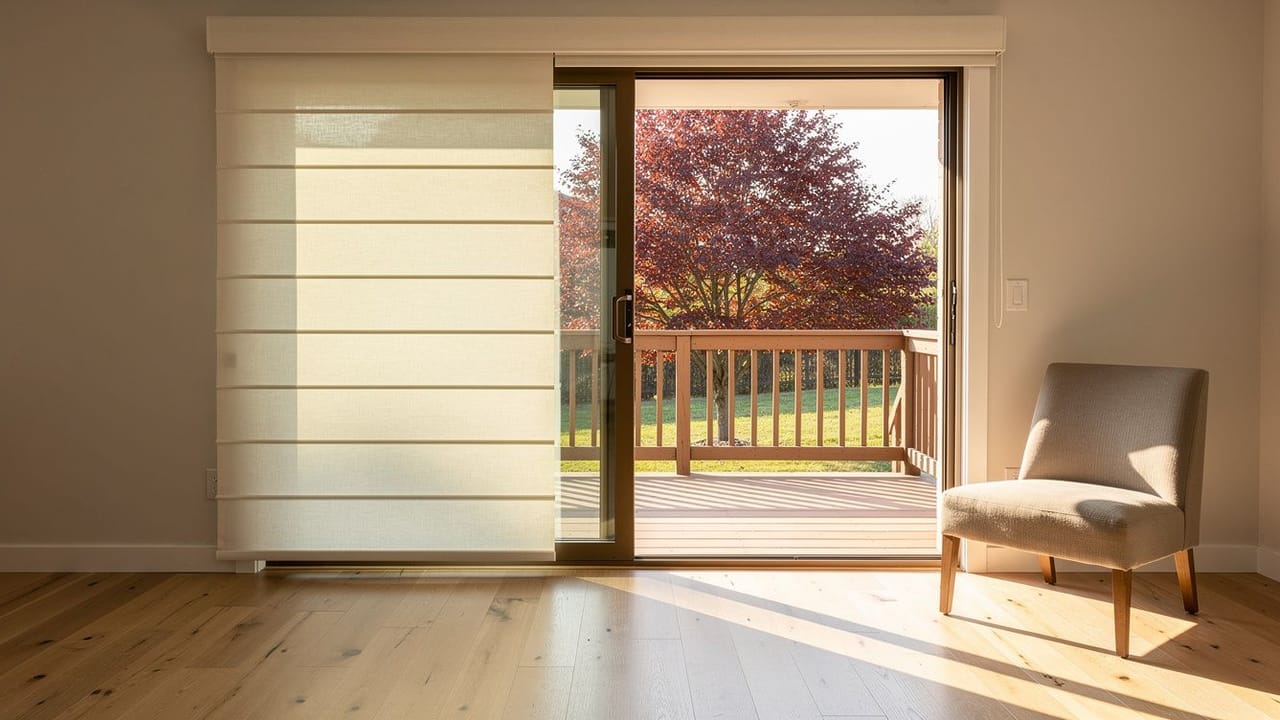
Panel track blinds are the same idea grown up: wide flat fabric panels, often the same material as roller shades, that slide on a multi-channel track and stack to one side or both. They read as clean and modern, and they come in room-darkening and solar fabrics. Both need room on the wall beside the door to stack, and how much depends on the product, the vane or panel width and the number of panels. We plan the stack on the fixed-glass side, away from the handle, so the half of the door you walk through is left clear.
How do shutters work on a sliding door?
Plantation shutters on a sliding door are built as a bypass or a bifold track system: panels on a top track that slide in front of each other, or fold and slide to one side. They match shutters on the rest of the house, and closed against the afternoon sun they keep it off the glass the way any shut covering does; the Department of Energy’s Energy Saver guide tells homeowners to keep window coverings closed during summer days to block the sun’s heat. The constraints are depth, because the track and panels stand out from the wall and have to clear the door handle, and clearance, because bypass panels stay stacked over part of the glass unless the track runs past the opening.
On a door that’s used constantly, sliding shutter panels are heavier to move than fabric and the track has to be sturdy. On a door used mostly for light and view, they’re the choice that looks most like part of the house.
- Vertical blinds: stack to one side, tilt for light, choose fabric or heavy vinyl
- Panel track: clean look, roller-shade fabrics, needs stacking room
- Bypass or bifold shutters: match the house, need depth and stacking room
- Drapery: softest look, can be lined against heat, takes the most wall
- Cellular vertical shades: honeycomb fabric on a sliding track, fewer styles
Drapery and the heat problem
Floor-length drapery on a traverse rod that extends well past the door on both sides covers a sliding door completely and stacks off the glass entirely, which no blind or shutter does. For heat, the same DOE guide recommends medium-colored draperies with white plastic backings and says to close draperies on windows that get direct sun on summer days. A backed or lined drape, drawn while the sun is on the door, puts that advice into practice. The cost is wall space for the stack-back, and a drape hanging beside a door to the yard picks up whatever comes in on paws and shoes. If there’s a floor register in front of the door, the guide also says to keep registers clear of drapes.
A solar shade or a light-filtering panel track cuts glare while keeping some of the view, which matters on a door that looks out at a yard you like. For a door that takes the full west sun, what we suggest is two layers: a solar shade or panel track for the day and a lined drape to close when the sun is on the glass. DOE also points to awnings on south- and west-facing windows and to sun-control film on east- and west-facing glass, and our post on window treatments that cut Nashville heat covers those options in more depth. In winter the guide suggests insulated cellular shades, the honeycomb kind, for openings that feel drafty.
What should you decide before ordering a door treatment?
Which way the door slides, and which side of the wall has room for the stack. Whether the treatment mounts inside the door frame or on the wall above and beyond it; on most sliders we mount outside, and our post on inside and outside mounts explains how we decide. How high the mount can go, because a track set close to the ceiling can make the door look taller and lifts the hardware well clear of the handle.
Whether children will be going through the door. Since May 30, 2023, the federal safety standard for operating cords on custom window coverings has required custom blinds and shades to be cordless or to keep the cord inaccessible, and its definition of an operating cord includes traversing, which is exactly what a vertical blind or panel track does as it draws across a door. Our post on cord safety goes through what that means for blinds already hanging in the house. With a dog that goes in and out, vanes hanging to the floor get pushed through every trip, so we lean toward panels or drapery there.
And how the door is actually used. A door that’s the main route to the yard wants something that opens with one motion and stays out of the way: a panel track or drapery on a rod. A door that’s mostly a window wants the light control and the look of shutters or a good vertical. If you want both options measured and priced on your own door, ask us for a free estimate.
Sources
- U.S. Department of Energy, Energy Saver: Tips on Saving Money and Energy in Your Home (2022) — Keep window coverings closed during summer days to block the sun’s heat; medium-colored draperies with white plastic backings; close draperies on windows receiving direct sun; awnings on south- and west-facing windows; sun-control films on east- and west-facing windows; insulated cellular shades for drafty windows; keep registers clear of drapes
- U.S. Consumer Product Safety Commission, 16 CFR Part 1260, Safety Standard for Operating Cords on Custom Window Coverings (2024 edition, govinfo.gov) — Effective May 30, 2023; custom coverings must meet the no-operating-cord or inaccessible-cord sections of ANSI/WCMA A100.1-2018; operating cord defined to include traversing
FAQ
Window Treatments for a Sliding Glass Door — questions
What is the best window treatment for a sliding glass door?
It depends on use. For a door in constant use, a panel track or drapery on a traverse rod opens with one motion and stacks out of the way. To match shutters elsewhere in the house, bypass or bifold shutters. For a rental, vertical blinds in fabric or heavier vinyl. For afternoon heat, the Department of Energy advises closing coverings on glass that takes direct summer sun, which a lined drape or a solar layer plus a drape lets you do.
Can plantation shutters go on a sliding door?
Yes, as a bypass or bifold system on a top track. The panels stand out from the wall, so they need clearance for the door handle and room beside the door to stack, and a bypass system leaves panels over part of the glass unless its track runs past the opening. They suit a door used mostly for light and view, and they match shutters elsewhere in the house.
How much space beside the door do blinds need to stack?
There is no single figure: it depends on the product, the vane or panel width and how many panels there are. The stack can sit on the wall beyond the opening if the headrail runs past the frame. Plan it on the fixed-glass side, away from the handle, so the half of the door you walk through stays clear, and get the stack measurement for the exact product before ordering.
Can you get blinds for sliding patio doors?
Yes. Vertical blinds in fabric or heavier vinyl stack to one side and tilt for light, panel track blinds slide wide fabric panels on a multi-channel track, and cellular vertical shades put honeycomb fabric on a sliding track. Plan the stack on the fixed-glass side, and on a custom order the cord must be gone or out of reach.