
· by Michael Blair, Nashville's Shutters and Blinds
In a Middle Tennessee house the windows are the weak point of the wall. An Oak Ridge National Laboratory report on cellular shades puts it in engineering terms, describing windows as having inferior thermal resistance compared with the rest of the building envelope. On a cold night you can feel that standing next to the glass, even where nothing is leaking. Blinds and shutters chosen for summer glare often do very little about it. The coverings that help in winter are the ones that trap a layer of still air against the window and close it off at the edges.
What slows heat loss at a window?
We look for three things: a layer of still air, a material that does not conduct heat well, and a fit that keeps room air from circulating behind the covering. A slatted blind does poorly on all three. In chamber tests for the Department of Energy, Pacific Northwest National Laboratory found closed venetian blinds insulated 67 percent less than a cellular shade, and noted that the blinds were not airtight, so room air still moved past them and warmed the glass.
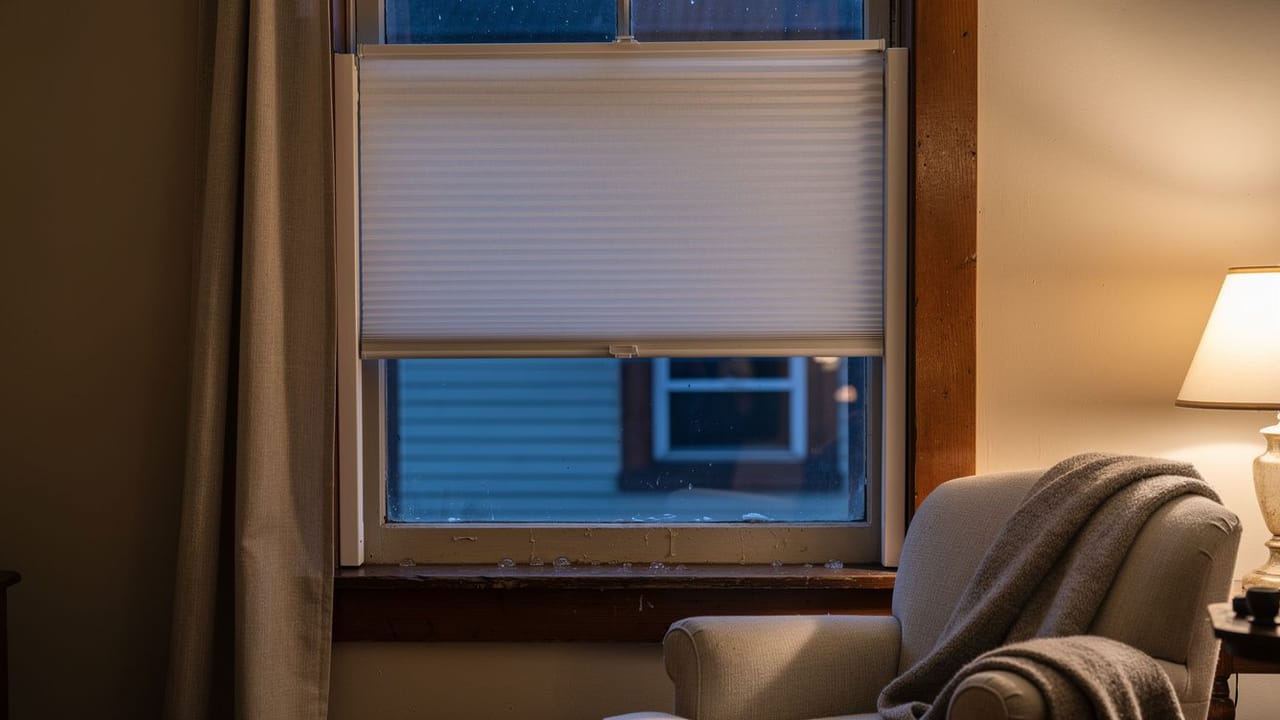
Cellular shades do best. The same PNNL report says honeycomb cellular shades typically have the highest R-values, because the cells trap air in pockets. The test closest to us ran in a house in Knoxville from December 2019 to May 2020: ORNL measured nighttime heating savings of 9 to 23 percent with cellular shades compared with closed venetian blinds. The double-cell shades tended to save more than the single-cell ones there, though the authors caution that the weather changed between runs, so the products cannot be compared directly. Shades running in side channels saved more than those without, which is why we fit channels where the frame allows, and why the DOE Energy Saver Guide asks for tight-fitting, insulating shades. Our shades page lists the cellular options we install.
Plantation shutters are harder to rank. Lawrence Berkeley National Laboratory’s window attachments study left louvered shutters and drapes out for lack of reliable simulation models, and we have not found a lab rating for interior shutters. We build plantation shutters to fit close to their frames with the louvers closing tight, but we would not promise a number for them. Drapes are the other common choice, and the DOE guide tells homeowners to close curtains and shades at night against cold drafts. A lined drapery panel that runs past the frame on both sides and reaches the sill or floor leaves less room for air to slip behind it, the same idea as a side channel on a shade.
Using them through the day
On a clear winter day a south-facing window takes in real warmth from the low sun, and a covering left closed throws that away. The DOE guide says to open draperies and shades on south-facing windows during the day and close them at night to reduce the chill from cold windows. The PNNL authors give the same advice for a second reason, which is that opening cellular shades by day lets any condensation dry. So we tell people to open the sunny windows in the morning and close everything at dusk.
Motorized shades make this routine easy, because a schedule does it every day without anyone thinking about it. In a 2018 ACEEE paper, PNNL researchers wrote that dynamic window coverings that are reliably controlled can dramatically reduce heating and cooling energy. For people who travel, or who leave for work before sunrise, a winter schedule is the part of motorization we think earns its keep, and our post on motorized blinds goes through the rest of the decision.
Why does condensation form behind a tight covering?
A covering that seals well against the glass also keeps the glass colder. The PNNL report explains that the added insulation cuts the amount of warm indoor air reaching the window, which lowers the temperature of the glass and frame, and water forms once that surface drops below the dew point. Single-glazed windows are the most prone, and we still see them in some older houses around Nashville. It is not only a cellular shade problem, either: in the same chamber tests, condensation formed behind venetian blinds and sheer shades as well.
A little of this on the coldest mornings is harmless if the shade is raised to let it dry, and PNNL adds that water left on the sill should be wiped off at least every few days. Left there morning after morning, it is a different matter. The report names window frame degradation and mold as the concern, and the EPA’s guide to mold and moisture lists condensation on the inside of a windowpane among the moisture problems to dry quickly, since the key to mold control is moisture control. PNNL’s fixes are a storm window or interior panel over the old sash, or raising the shade’s bottom rail half an inch off the sill. That half inch cut the condensation sharply and cost the shade 39 percent of its R-value, so most of the benefit stayed; wider openings at the top and bottom cut it by 63 to 71 percent. The authors do not recommend lowering indoor humidity as the fix unless it is extremely high. For reference, the EPA puts the ideal indoor range at 30 to 50 percent relative humidity.
- Raise tight shades during the day so glass and sill dry out
- Wipe standing water off the sill every few days
- Run the bath fan when showering and the kitchen fan when cooking
- Consider a storm window, or a half-inch gap under the shade, on old glass
Choosing for both seasons
A Nashville house needs coverings that work through hot summers and cold winters. A cellular shade with a light or reflective backing helps on summer afternoons, and the same cells hold heat in winter; the PNNL report notes the air pockets can be lined with a metalized layer that reduces conductive and radiant heat transfer. That is why cellular shades are the usual answer on a room that is uncomfortable year-round. One caution if they are motorized: the ORNL team closed their shades from 6 p.m. to 6 a.m. to save heat, and that same schedule cost energy in the cooling season, so the program should change with the seasons. To compare products, the DOE guide points to energy ratings from the Attachments Energy Rating Council.
Where shutters are already installed and a room is still cold, we usually suggest trying a lined drape over them before anyone talks about replacing them. Where the windows themselves are failing, with loose sash and gaps you can feel, no covering will fix it. The PNNL authors call improving the window the most logical way to deal with condensation in cold climates, and the DOE guide says low-e storm windows can save 10 to 30 percent on heating and cooling costs, depending on the window already there. If you are not sure which side of that line your windows are on, ask us to come and look.
Sources
- Pacific Northwest National Laboratory, Evaluation of the Thermal and Moisture Performance of Insulating Shades, PNNL-33380 (2022) — Cellular shades have the highest R-values; closed venetian blinds insulate 67 percent less and are not airtight; tight shades lower glass temperature and raise condensation risk; condensation also forms behind blinds and sheer shades; open shades by day and wipe the sill; a 0.5 inch bottom gap cuts R-value 39 percent, larger openings 63 to 71 percent; storm windows preferred to lowering humidity; metalized cell linings
- Oak Ridge National Laboratory, Evaluation of Interior Cellular Shades in a Residential Building, ORNL/TM-2020/1822 (2021) — Windows have inferior thermal resistance; Knoxville test, December 2019 to May 2020, 9 to 23 percent nighttime savings against venetian blinds; side channels saved more; 6 p.m. to 6 a.m. schedule caused a cooling penalty
- U.S. Department of Energy, Energy Saver Guide: Tips on Saving Money and Energy at Home (2022) — Tight-fitting insulating shades; open south-facing coverings by day and close them at night; close curtains at night against drafts; AERC ratings; low-e storm windows save 10 to 30 percent
- Cort et al., Completing the Connected Home with Smart Window Shades, ACEEE Summer Study (2018) — Reliably controlled dynamic window coverings can dramatically reduce heating and cooling energy
- Lawrence Berkeley National Laboratory, Residential Windows Attachments — Louvered shutters and drapes left out of the study for lack of reliable simulation models
- U.S. EPA, A Brief Guide to Mold, Moisture and Your Home (updated 2026) — Key to mold control is moisture control; dry window condensation quickly; ideal indoor humidity 30 to 50 percent; run bath and kitchen exhaust fans
- Attachments Energy Rating Council — Energy ratings for window attachments, as recommended in the DOE guide
FAQ
Window Coverings That Hold Heat in Winter — questions
Do cellular shades really help in winter?
Yes. Among interior coverings, honeycomb cellular shades typically have the highest insulating values, because the cells trap still air. In an Oak Ridge National Laboratory test in a Knoxville house, they saved 9 to 23 percent of nighttime heating energy compared with closed venetian blinds. A close fit, and side channels where they are available, add to the effect.
Are plantation shutters good insulation?
We have not found them rated in the government and laboratory studies we have read, so we cannot give a number. A shutter fitted close to its frame with the louvers shut leaves little room for air to move, but for a cold room the tested choice is a well-fitted cellular shade, and a lined drape over existing shutters is worth trying first.
Why do my windows drip water behind the blinds in winter?
The covering keeps warm room air off the glass, so the glass gets colder than the dew point of the air behind it. In laboratory tests it happened behind cellular shades, venetian blinds and sheer shades alike, and single-pane windows are the most prone. A storm window, opening the covering during the day and leaving a half-inch gap under the bottom rail all reduce it; lowering indoor humidity helps mainly when it is unusually high.
Should you keep blinds closed in winter?
Close them at night, when a shut covering keeps the chill of cold glass out of the room. On clear days, open the ones on south-facing windows so the low winter sun can warm the house and any condensation behind a tight shade can dry. The Department of Energy’s guide gives that same day-and-night routine.